

David Spiteri Books In Order
-

The Prez
[ March, 2012 ] -
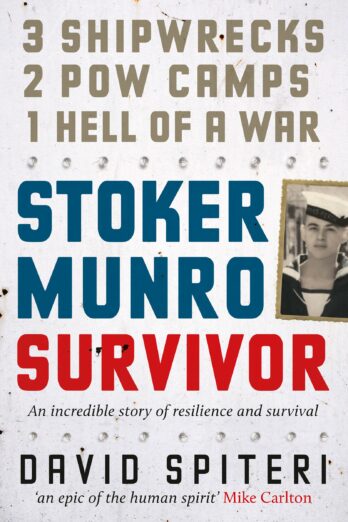
Stoker Munro: Survivor
[ June, 2014 ] -



About David Spiteri
Genres
David Spiteri Bio
Few Australian authors arrive at the page with a life story as singular as David Spiteri’s. Where most writers build their authority through study or craft, he built his through four decades of direct experience inside one of Australia’s first outlaw motorcycle clubs, and when he finally sat down to write about it, the existing accounts of that world weren’t good enough for him, so he wrote his own.
Spiteri started writing his debut book roughly ten years before it came out, while recovering in hospital from a serious motorcycle accident. His mates dropped off books for him to read, mostly about bikies, and he found them exploitative, sensationalist and lacking any real feel for the culture from the inside. That dissatisfaction became the engine behind everything he has published since.
His debut, The Prez, came out through HarperCollins on 1 March 2012 and runs to 510 pages. It is the true story of forty years inside one of Australia’s first outlaw motorcycle clubs, as told by its one-time president, covering previously unrevealed ground on the outlaw world of extreme violence, drugs, corruption, sex, treachery and retribution. Because it draws directly on real events and real people, all names have been changed and identities and events obscured, the only way the story could responsibly be told. The result is a book that occupies an unusual place in Australian true crime: a memoir and a fictionalised narrative at once, personally sourced and impossible to copy.
In The Prez, Spiteri fictionalises his involvement in and knowledge of bikie culture up to 1985. The writing is raw but remarkably easy to read, and despite its considerable length it keeps its momentum throughout. He is candid in a way that few insiders ever manage, giving readers a wealth of credible and highly entertaining stories about motorcycle club subculture in Australia. Around the time it came out, he appeared widely in Australian media to promote it, including an interview with Trevor Chappell on ABC Radio.
His second book went in a very different direction. Stoker Munro: Survivor came out through HarperCollins in Sydney in 2014 and runs to 263 pages, including photographs, illustrations and maps. It is a moving account of a young sailor’s war, as told to his close friend David Spiteri. That sailor was Stoker Lloyd William Munro of HMAS Perth, who survived two shipwrecks, the first at the hands of the Japanese and the second at the hands of the US Navy, then several Japanese prisoner of war camps and the infamous Burma Railway. HMAS Perth went down on 1 March 1942 during the Battle of Sunda Strait, and Munro was among the survivors who then endured years of brutal captivity. Spiteri interviewed him roughly sixty years after the war, with the story starting in mid-February 1942. Stoker’s voice, clear, distinctive, laidback and larrikin, with a knack for finding humour in almost any situation, captures much of what has come to define the ANZAC spirit: courage, resilience, and the sheer refusal to give in. It is a collaboration across a friendship in every sense, with Spiteri as recorder and shaper, and Munro as witness and voice.
The Biker and the Banker’s Daughter followed on 1 July 2014, published under the HarperCollins Impulse imprint, running to 90 pages and classified as a contemporary romance novella. Like The Prez, it portrays real events, though the author could not identify the real people involved, so all names and identifying characteristics of the main protagonists were modified, along with the names of clubs and locations where the actual events took place. It draws on the same world as his debut, with motorcycle clubs, loyalty, and the pull between two very different lives, told through the lens of a love affair rather than a chronicle.
Across his three published books, Spiteri has worked in true crime memoir, oral military history and romantic fiction, a range that reflects both the breadth of his lived experience and his willingness to follow a story wherever the material leads. All three came out through HarperCollins Australia, one of the country’s largest commercial publishers. He has indicated that more books are on the way.
David Spiteri lives in Rosebank, Northern New South Wales.
David Spiteri FAQs
Who is David Spiteri?
He was a founding member and long-time President of one of Australia’s first outlaw motorcycle clubs, from its start in the early 1960s through to the early 2000s. He is the author of three books published by HarperCollins Australia, The Prez, Stoker Munro: Survivor, and The Biker and the Banker’s Daughter, and he lives in Rosebank, Northern NSW.
What books has David Spiteri written?
What is The Prez about?
In it, Spiteri fictionalises his involvement and knowledge of bikie culture up until 1985.
It came out through HarperCollins on 1 March 2012 and runs to 510 pages.
What is Stoker Munro: Survivor about?
Spiteri interviewed him roughly 60 years after the war, recording an account that spans the full arc of one sailor’s extraordinary survival. It came out through HarperCollins in Sydney in 2014.
What is The Biker and the Banker’s Daughter about?
Like The Prez, it portrays real events, though names and identifying characteristics of the main protagonists were modified, along with the names of clubs and locations, because the author couldn’t identify the real people involved.
It came out on 1 July 2014 under the HarperCollins Impulse imprint and runs to 90 pages.